United States Healthcare Discount Plan Market Size, Trends, Analysis & Forecast 2034
About
IMARC Group has recently released a new research study titled “United States Healthcare Discount Plan Market Size, Share, Trends and Forecast by Service, and Region, 2026-2034”, offers a detailed analysis of the market drivers, segmentation, growth opportunities, trends and competitive landscape to understand the current and future market scenarios.
United States Healthcare Discount Plan Market Outlook 2034: Opportunities in Affordable Healthcare Access
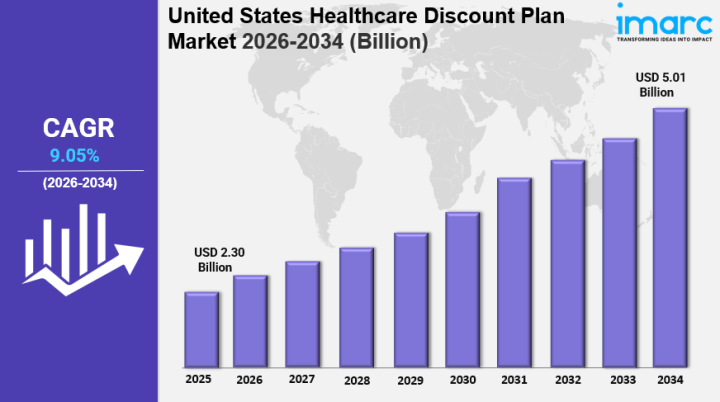
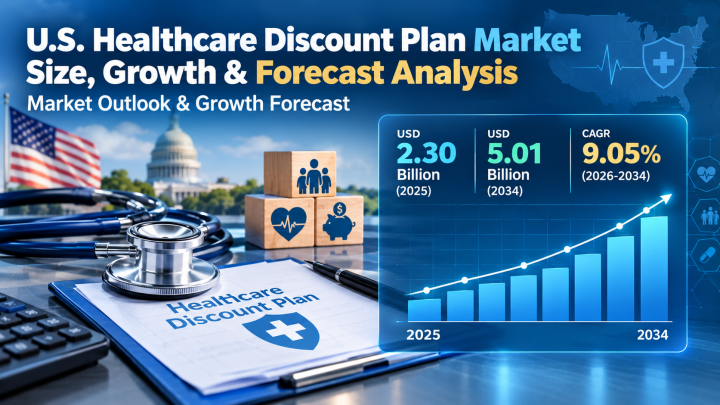
The United States healthcare discount plan market size was valued at USD 2.30 Billion in 2025 and is projected to reach USD 5.01 Billion by 2034, growing at a compound annual growth rate (CAGR) of 9.05% from 2026-2034. Rising medical costs and the need for affordable care are pushing consumers toward plans that offer pre-negotiated savings on dental, vision, prescription drugs, and telehealth services. For plan providers, healthcare networks, pharmacies, and technology partners, understanding the latest United States healthcare discount plan market trends is essential to capture this expanding opportunity.
Key Market Statistics at a Glance
Base Year: 2025
Historical Years: 2020–2025
Forecast Period: 2026–2034
Market Size (2025): USD 2.30 Billion
Projected Size (2034): USD 5.01 Billion
Growth Rate: CAGR of 9.05%
Explore Growth Opportunities in the United States Healthcare Discount Plan Market. Grab Your Sample Report for Evaluation: https://www.imarcgroup.com/united-states-healthcare-discount-plan-market/requestsample
The United States healthcare discount plan market size of USD 2.30 Billion in 2025 is set to more than double by 2034, reflecting a positive outlook as rising healthcare expenditures continue pushing consumers toward affordable alternatives. A focused United States healthcare discount plan market analysis shows that strategic partnerships between plan providers and healthcare facilities, together with evolving United States healthcare discount plan market trends, will further expand service accessibility.
How Telehealth and Consumer-Driven Care Are Transforming the United States Healthcare Discount Plan Market
Consumers increasingly prioritize affordability, price transparency, and convenience in their healthcare decisions. The overall United States healthcare discount plan market growth is being shaped by the integration of virtual care, digital cost-comparison tools, and wider provider access, positioning discount plans as modern and flexible alternatives to traditional coverage.
Key United States Healthcare Discount Plan Market Trends:
• Telehealth Integration: Discount plans are adding virtual primary care, mental health, and behavioral health consultations, making non-emergency care more reachable while reducing overall costs. In 2025, Health In Tech announced a collaboration with telehealth provider DialCare to bring such services to its self-funded health plan offerings.
• Consumer-Driven Healthcare: Patients want clear pricing, service options, and care quality information. In August 2025, Blue Shield of California launched a digital experience that delivers real-time prescription cost comparisons and lower-cost alternatives to members through mobile app notifications.
• Network Expansion: Providers are widening their networks so enrollees can access discounted services across multiple specialties. Extended Medicare telehealth flexibilities in 2025 also enabled more providers to deliver virtual care, supporting broader network accessibility nationwide.
United States Healthcare Discount Plan Market: Key Growth Drivers and Strategic Insights for Stakeholders
Several factors are supporting the steady rise in enrollment for discount memberships. The aging population requiring more healthcare services, combined with growing awareness of plan benefits, is expected to sustain strong enrollment through 2034 and support continued United States healthcare discount plan market growth.
Key United States Healthcare Discount Plan Market Growth Drivers:
1. Escalating Healthcare Expenditures: Rising costs of medical services, prescription medications, and administrative expenses are leading consumers to seek affordable alternatives. A recent Gallup poll found that nearly one-quarter of Americans say the U.S. healthcare system is in crisis, with high costs cited as the most urgent issue.
2. Growing Uninsured and Underinsured Populations: Many Americans are ineligible for subsidies or find premiums out of reach. According to the U.S. Census Bureau, the uninsured rate for people under age 65 in many counties remained above 9% in 2023, highlighting persistent coverage gaps.
3. Consumer-Driven Healthcare Transformation: Stronger enforcement of the CMS Hospital Price Transparency Rule is empowering consumers to compare costs before seeking care, and discount plans align with this expectation through upfront pricing and direct access to discounted services.
Strategic Insights:
• Strengthen Plan Communication: Many consumers mistake discount plans for insurance. Clear explanation of scope, exclusions, and limitations helps set realistic expectations and improves member satisfaction.
• Expand and Standardize Networks: Network gaps, particularly in rural communities, reduce plan appeal. Broader and more consistent networks improve competitiveness across regions.
• Build Strategic Partnerships: Collaborations with healthcare facilities, pharmacies, and technology platforms are expected to expand service accessibility and support long-term growth.
Why Consumers Are Choosing Healthcare Discount Plans Across the United States
The sustained United States healthcare discount plan market demand reflects the tangible value they deliver to individuals facing high out-of-pocket expenses, including those with high-deductible health plans.
Reasons for Adoption:
• Immediate Savings: Plans offer discounts on a range of medical services without deductibles or waiting periods.
• Simplicity: Members get upfront pricing and direct access to discounted services without complex claims processes.
• Broader Service Coverage: Plans cover services often excluded from traditional insurance, including dental, vision, and alternative medicine.
United States Healthcare Discount Plan Market Segmentation:
Prescription drugs lead the service segment, accounting for 18% of the United States healthcare discount plan market share in 2025, supported by continuously rising medication costs and the need for affordable access to essential pharmaceuticals. This leadership is expected to continue as specialty drug prices rise and pharmacy partnerships expand.
Service Insights:
• Health Advocate
• Virtual Visits
• Alternative Medicines
• Prescription Drugs
• Dental Care
• Vision Care
• Hearing Aids
• Chiropractic Care
• Nurse Services
• Vitamins and Supplements
• Wellness Plans
• Podiatry Plans
• Others
Regional Insights:
Regional United States healthcare discount plan market demand varies with population density, insurance coverage patterns, and income levels across four regions:
• Northeast: Dense metropolitan populations and high costs at premium facilities push middle-income urban consumers toward discount plans.
• Midwest: Established employer-sponsored healthcare and an aging population drive steady, stable adoption of supplementary savings plans.
• South: High uninsured and underinsured populations and prevalent chronic diseases create strong demand for affordable essential services.
• West: The fastest-growing region, supported by diverse demographics, rising health awareness, and increasing telehealth integration.
Speak to an Analyst: https://www.imarcgroup.com/request?type=report&id=30056&flag=C
Competitive Landscape and Notable Industry Activity
The competitive structure is fragmented, with discount medical plan organizations competing alongside established healthcare and insurance companies for United States healthcare discount plan market share. This United States healthcare discount plan market analysis of competitors shows that large players leverage extensive provider networks and brand recognition, while regional providers differentiate through specialized offerings and local expertise. Notable recent activity includes:
• UnitedHealthcare – Launched the UHC Store in September 2025, a direct-to-consumer marketplace broadening access to discounted wellness programs and benefits.
• GoodRx – Expanded its partnership with Kroger’s healthcare division in 2025 to offer discounted branded medications at Kroger pharmacies nationwide.
• Blue Shield of California – Introduced real-time prescription cost comparisons for members via mobile app notifications in August 2025.
• Health In Tech – Partnered with DialCare in 2025 to integrate virtual primary care and mental health services.
• Included Health – Launched Dot in December 2025, an AI-powered personal health assistant that helps patients navigate benefits and care.
Looking ahead, the strong demand outlook and ongoing innovation in plan design are expected to keep the United States healthcare discount plan market demand on a positive path through 2034. A detailed United States healthcare discount plan market analysis, along with the latest United States healthcare discount plan market share insights, is available in the full IMARC report.
Author IMARC Group
IMARC Group is a leading global management consulting firm providing comprehensive market research, feasibility studies, and strategic advisory services. The firm supports organizations worldwide in identifying growth opportunities, mitigating risks, and making informed business decisions across industries.
Contact Us
IMARC Group
Email: sales@imarcgroup.com
United States: +1-201-971-6302
- Price $2,999.00
- Location United States [map]