Argentina Grain Market Size Growth & Industry Demands Report 2034
Posted by Nitin Sharma
Filed in Other 0 views
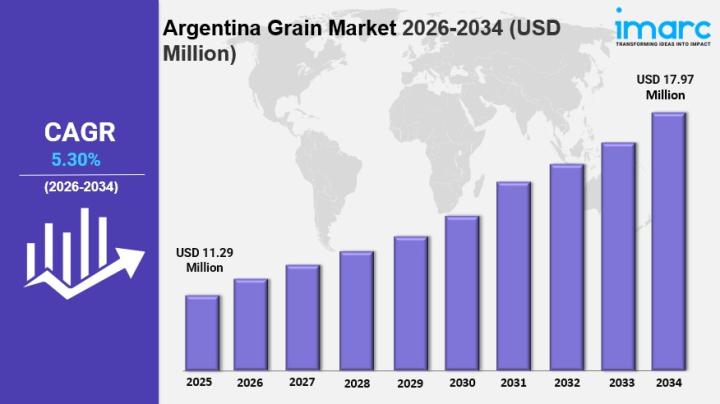
IMARC Group has recently released a new research study titled “Argentina Grain Market Size, Share, Trends and Forecast by Product Type, Application, End User, Farm Type, and Region, 2026-2034”, offers a detailed analysis of the market drivers, segmentation, growth opportunities, trends and competitive landscape to understand the current and future market scenarios.
Argentina Grain Market Outlook 2034: Opportunities for Agribusiness Stakeholders
The Argentina grain market size is on a steady growth trajectory, projected to expand from USD 11.29 Million in 2025 to USD 17.97 Million by 2034. This expansion, reflecting a compound annual growth rate (CAGR) of 5.30% from 2026 to 2034, presents meaningful opportunities for producers, processors, and exporters. Supportive government policies, expanding irrigation, and greater value-added processing are shaping the Argentina grain market growth story, making it essential for agribusiness stakeholders to understand the dynamics ahead.
Key Market Statistics at a Glance
Base Year: 2025
Historical Years: 2020–2025
Forecast Period: 2026–2034
Market Size (2025): USD 11.29 Million
Projected Size (2034): USD 17.97 Million
Growth Rate: CAGR of 5.30%
Explore Growth Opportunities in the Argentina Grain Market. Grab Your Sample Report for Evaluation: https://www.imarcgroup.com/argentina-grain-market/requestsample
How Technology and Irrigation Trends Are Transforming the Argentina Grain Market
Technology and infrastructure are reshaping how grain is grown, stored, and exported in Argentina. Farmers are adopting precision farming tools, irrigation networks are being upgraded, and processors are moving up the value chain. Together, these Argentina grain market trends are improving yields, cutting costs, and strengthening Argentina’s position as a dependable global supplier. AI-powered platforms that combine satellite data, weather analytics, and machine learning are also helping farmers optimize water use, detect pest or disease outbreaks early, and forecast yields more accurately.
Key Trends:
• Expansion of Irrigation and Infrastructure Modernization: Drip and sprinkler systems, new grain storage facilities, better rail links, and upgraded ports are supporting year-round farming and reducing post-harvest losses.
• Integration of AI and Precision Agriculture: GPS-guided equipment, drones, IoT sensors, and AI-driven analytics help farmers fine-tune planting, fertilization, and pest control while lowering input costs. These emerging Argentina grain market trends also strengthen climate risk management.
• Rise of Value-Added Processing and Export Diversification: Investment in crushing, milling, and biofuel facilities is turning soybeans, corn, and wheat into oils, flours, and ethanol, while new buyers in Asia and Africa help meet Argentina grain market demand beyond traditional destinations.
Argentina Grain Market: Key Growth Drivers and Strategic Insights for Businesses
Several factors are driving the Argentina grain market forward. Policy reforms that reduced agricultural export taxes have improved farmer profitability, while rising global appetite for high-quality grains continues to lift Argentina grain market demand. At the same time, expanding domestic soybean processing has helped Argentina regain its position as the leading global exporter of soybean meal and oil, strengthening the Argentina grain market share captured across the value chain.
Key Growth Drivers:
• Supportive Government Policies: Lower export taxes improve producer returns and encourage forward sales.
• Infrastructure Investment: World Bank and Inter-American Development Bank funding is enhancing irrigation capacity and climate resilience in key agricultural regions.
• Domestic Processing Capacity: Growth in soybean crushing supports higher-value exports of meal and oil.
• Technology Adoption: AI-driven crop monitoring and precision agriculture improve yields and resource efficiency.
Strategic Insights:
• Invest in Value-Added Processing: Businesses should look at crushing, milling, and biofuel capacity to capture more value and reduce reliance on raw commodity exports.
• Adopt Digital Agriculture: Precision farming and AI-based monitoring can raise yields and protect margins against climate variability.
• Build Climate Resilience: Expanding irrigation and using drought-resistant crop varieties can stabilize output and long-term returns.
Why Agribusinesses Are Investing in Argentina’s Grain Sector
Agribusiness players are increasingly recognizing the long-term potential of Argentina’s grain sector. The combination of policy support, infrastructure upgrades, and technology adoption is improving profitability and supporting sustained Argentina grain market growth through 2034.
Reasons for Investment:
• Improved Profitability: Reduced export taxes and better risk management strengthen returns for farmers and exporters.
• Operational Efficiency: AI and precision agriculture optimize inputs, cut costs, and improve decision-making through the growing season.
• Export Competitiveness: Better ports, rail links, and storage help exporters protect margins and win a larger Argentina grain market share in global trade.
• Rising Global Demand: Growing international interest in high-quality and processed grain products is lifting Argentina grain market demand and rewarding efficient producers.
Key Challenges to Watch
A balanced Argentina grain market analysis must also consider the hurdles facing the sector. Sustained Argentina grain market growth will depend on how well stakeholders manage these risks:
• Climate Variability and Water Scarcity: Unpredictable rainfall, droughts, and extreme weather disrupt yields and planting schedules, especially in rainfed regions.
• Economic Volatility and Policy Uncertainty: Currency swings, inflation, and changes in export taxes affect profitability and long-term investment.
• Infrastructure Bottlenecks and Logistics Inefficiencies: Aging road and rail networks, port congestion, and limited storage raise costs and increase post-harvest losses.
Argentina Grain Market Segmentation:
The report offers in-depth Argentina grain market analysis and forecasts at the country and regional levels for 2026-2034, tracking Argentina grain market size by product type, application, end user, and farm type.
Product Type Insights:
• Soybeans
• Corn
• Wheat
• Barley
• Oats
Application Insights:
• Animal Feed
• Food and Beverages
• Industrial Use
End User Insights:
• Commercial Farmers
• Agricultural Cooperatives
• Exporters
Farm Type Insights:
• Small-scale Farms
• Large-scale Farms
Regional Insights:
• Buenos Aires Region
• Litoral Region
• Northern Region
• Cordoba Region
• Cuyo Region
• Patagonia Region
Speak to an Analyst: https://www.imarcgroup.com/request?type=report&id=44227&flag=C
Competitive Landscape of the Argentina Grain Market
The competitive landscape is characterized by a mix of large-scale agribusinesses and mid-sized producers competing across production, processing, and export. Domestic players are pursuing vertical integration into grain processing and feed production to improve margins and reduce exposure to global price swings, while emerging producers invest in sustainable practices and efficiency-enhancing technologies. Companies tracking Argentina grain market share and Argentina grain market trends will find that the following areas are shaping competition:
• Vertical Integration: Grain processing and feed production improve margins and reduce price exposure.
• Sustainable Farming and Technology: Emerging producers use efficiency-enhancing tools to stay competitive.
• Logistics Modernization and Export Diversification: Strategic partnerships and new export markets strengthen overall resilience.
Author IMARC Group
IMARC Group is a leading global management consulting firm providing comprehensive market research, feasibility studies, and strategic advisory services. The firm supports organizations worldwide in identifying growth opportunities, mitigating risks, and making informed business decisions across industries, including in-depth Argentina grain market analysis.
Contact Us
IMARC Group
Email: sales@imarcgroup.com
United States: +1-201-971-6302