الاشعارات

Not merely because it is the longest chapter in the Quran.
Not merely because it contains many rulings.
And not merely because people have grown used to linking it with long recitations in the nights of Ramadan.
Rather, Surah Al-Baqarah is, in its essence, a chapter of rebuilding the human being.
And Ramadan, at its core, is not the month of hunger.
It is the month of re-formation.
For the rest of the year, a person lives scattered.
His desires pull him.
His habits rule him.
His fears leak into his decisions.
And he thinks he is free, while in truth he is often captive to what he has grown used to.
Then Ramadan arrives, and God says to him in a silent majesty:
Pause.
Look at yourself.
Who is leading you?
Your heart, or your appetite?
Your faith, or your habit?
Your soul, or your repetitive daily routine?
And here comes Surah Al-Baqarah, not merely to be recited, but to serve as a complete psychological and behavioral program.
At its beginning, it offers a precise division of the human inner world:
a believer,
a disbeliever,
and a hypocrite.
It is as if the surah tells you from the very first moments:
before you continue the journey, identify your inner position.
Who are you when no one is watching?
Who are you when desire rises?
Who are you when fear appears?
Who are you when personal interest collides with truth?
And this is the first psychological question of Ramadan:
Are you fasting only with your body,
or are you redefining yourself from within?
The story of Adam is not merely a tale of beginnings.
It is a permanent diagnosis of human nature.
The human being wants,
desires,
forgets,
weakens,
then falls,
and then can return.
Ramadan is not the month of impossible perfection.
It is the month of possible repentance.
The month of return.
The month of admitting that you are not flawless,
but you are still capable of coming back.
That is why Surah Al-Baqarah is so deeply connected to Ramadan.
It does not ask you to become sinless.
It asks you not to insist on your sin.
And here we enter a profound psychological depth.
In Surah Al-Baqarah there is a long exposure of the human condition when it knows the truth but does not obey it,
when it argues in order to escape,
debates in order to delay,
and asks for details not in order to act,
but in order to avoid acting.
How many people today do this in Ramadan?
They ask much,
delay much,
and change little.
They know the virtue of night prayer, yet they do not stand.
They know the value of the Quran, yet they do not open it.
They know life is short, yet they live as if they will remain forever.
Surah Al-Baqarah exposes this illness with stunning precision:
the illness of procrastination,
the illness of hardness of heart,
the illness of manipulating commands,
the illness of outward religiosity without inward transformation.
It is as though the surah is telling you:
the problem is not that you do not know.
The problem is that you know, and still do not move.
And here Surah Al-Baqarah truly becomes the surah of Ramadan.
Because Ramadan is not a season of information.
It is a season of transformation.
“O you who believe, fasting has been prescribed for you as it was prescribed for those before you, so that you may attain taqwa.”
This verse does not present fasting as deprivation.
It presents it as treatment.
In behavioral psychology, one of the greatest victories a person can achieve
is the ability to delay desire,
and to lead the self instead of being led by it.
Fasting trains you in this.
It reorganizes your relationship with hunger,
with desire,
with habit,
with impulse,
with immediate gratification.
You do not leave food because you are unable.
You leave it while fully able.
And here, a new kind of human being begins to emerge.
A person who says to himself:
I can refrain.
I can control myself.
I can say no.
And this small word — no —
is the beginning of every psychological maturity,
every behavioral success,
and every spiritual ascent.
That is why fasting appears inside Surah Al-Baqarah and not outside it.
Because the entire surah is already a project for building a disciplined, aware, responsible human being.
It contains charity.
It contains inner striving.
It contains patience.
It contains the change of qiblah.
It contains obedience even when one does not fully grasp the wisdom at once.
It contains steadiness when direction changes.
And all of this is Ramadan.
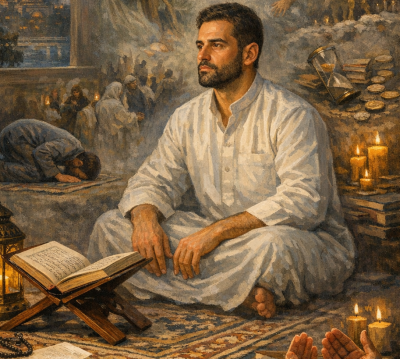
Ramadan is not merely abstaining from food.
It is the reorientation of the soul’s qiblah:
from habit to worship,
from consumption to meaning,
from distraction to direction,
from the noise of the body to the voice of the spirit.
That is why the one who lives with Surah Al-Baqarah in Ramadan
feels he is not simply reading a chapter,
but entering a school.
Every section pulls you away from an illusion
and places you before a truth.
Every ruling develops a muscle of the soul.
Every story reveals an inner flaw you once thought was normal.
And why does it stand at the center of this structure?
Because the self cannot be upright until it knows who God is.
Many deep psychological disturbances are, at their root,
disturbances of perception:
excessive fear,
excessive attachment,
the illusion of control,
anxiety about the future,
terror of loss,
collapse before created things.
Then Ayat Al-Kursi comes
and rearranges the entire universe inside your heart.
God is Ever-Living.
Self-Subsisting.
He does not neglect.
He does not sleep.
He knows.
He preserves.
He owns.
He governs.
And when this meaning settles within you,
your heart becomes calm.
That is why Surah Al-Baqarah in Ramadan
is not merely a chapter of legal rulings.
It is a chapter of psychological safety.
“Our Lord, do not take us to task if we forget or make a mistake.
Our Lord, do not lay upon us a burden as You laid upon those before us.
Our Lord, do not burden us with what we have no strength to bear.
Pardon us, forgive us, and have mercy on us.”
And here the journey reaches its most beautiful point.
After the building,
after the obligations,
after the striving,
after the exposure of the soul’s diseases,
God does not leave you relying on your own strength.
Rather, He teaches you to say:
My Lord, help me.
And this is the secret of Ramadan.
You do not triumph by yourself alone,
but by the help of God.
You do not become purified by your own power,
but by His mercy.
Because Ramadan seeks to produce four things in you,
and Surah Al-Baqarah builds all four:
First: awareness.
It reveals your soul to you as it truly is.
Second: discipline.
It trains you in obedience and control over desire.
Third: meaning.
It connects worship to guidance, not to empty form.
Fourth: supplication and dependence on God.
It returns you to Him at the end of every struggle.
That is why Surah Al-Baqarah is the surah of Ramadan.
Because it does not merely fill time.
It re-engineers the heart.
It is a surah that, if read through the eye of habit, appears long.
But if read through the eye of insight, appears healing.
It is not a chapter of many pages.
It is a chapter of many mirrors.
Each verse says to you:
Look.
Here is your weakness.
Here is your cure.
Here is your way back to God.
If many Muslims recite Surah Al-Baqarah in Ramadan,
the real question is not: how many pages did you finish?
The real question is: how many doors opened in your heart?
How many habits broke?
How many meanings awakened?
How many times did you feel that the Quran was not merely addressing your ears,
but rewriting your inner self?
And this is where quranesh.com becomes valuable.
It is not merely a website for learning words.
It is a bridge restoring the connection between the Muslim and meaning.
Because the greatest loss is not simply to recite the Quran with your tongue,
but to pass by its treasures without entering them.
At quranesh.com, the journey of understanding Quranic Arabic begins in a practical and accessible way,
so that Surah Al-Baqarah — and the rest of the Quran — does not remain only majestic sound,
but becomes living messages:
understood by your mind,
felt by your heart,
and capable of turning Ramadan
from a passing season of worship
into a true turning point in your life.